
ALNETS · Technical articles
High-Yield Breakthrough with Legacy Professional GPUs: Practical Guide to Enterprise MiniMax-H3 Image Generation and 27B LLM Inference Workstation Based on V100 32GB
A systematic engineering solution to the computing cost dilemma for mid-sized enterprises adopting generative AI: recurring public cloud API bills escalate rapidly with proprietary data compliance risks, while bleeding-edge enterprise GPUs demand prohibitive capital expenditure. Explores an end-to-end practical workstation architecture powered by the NVIDIA Tesla V100 32GB: detailing how HBM2 900 GB/s high memory bandwidth unleashes decisive throughput advantages for both large language model token generation and Diffusion image synthesis. Covers production deployment of MiniMax-H3 within ComfyUI pipelines under tight VRAM budgeting (1.5s/image fast throughput), as well as Qwen3-27B INT4/GGUF local inference and PagedAttention KV Cache allocation. Paired with ALNETS AiW-V professional compute workstation featuring custom forced-air wind tunnel cooling, PCIe expansion topologies, and quiet power delivery, backed by a rigorous TCO payback analysis achieving full hardware ROI within 1.5 to 2 months.
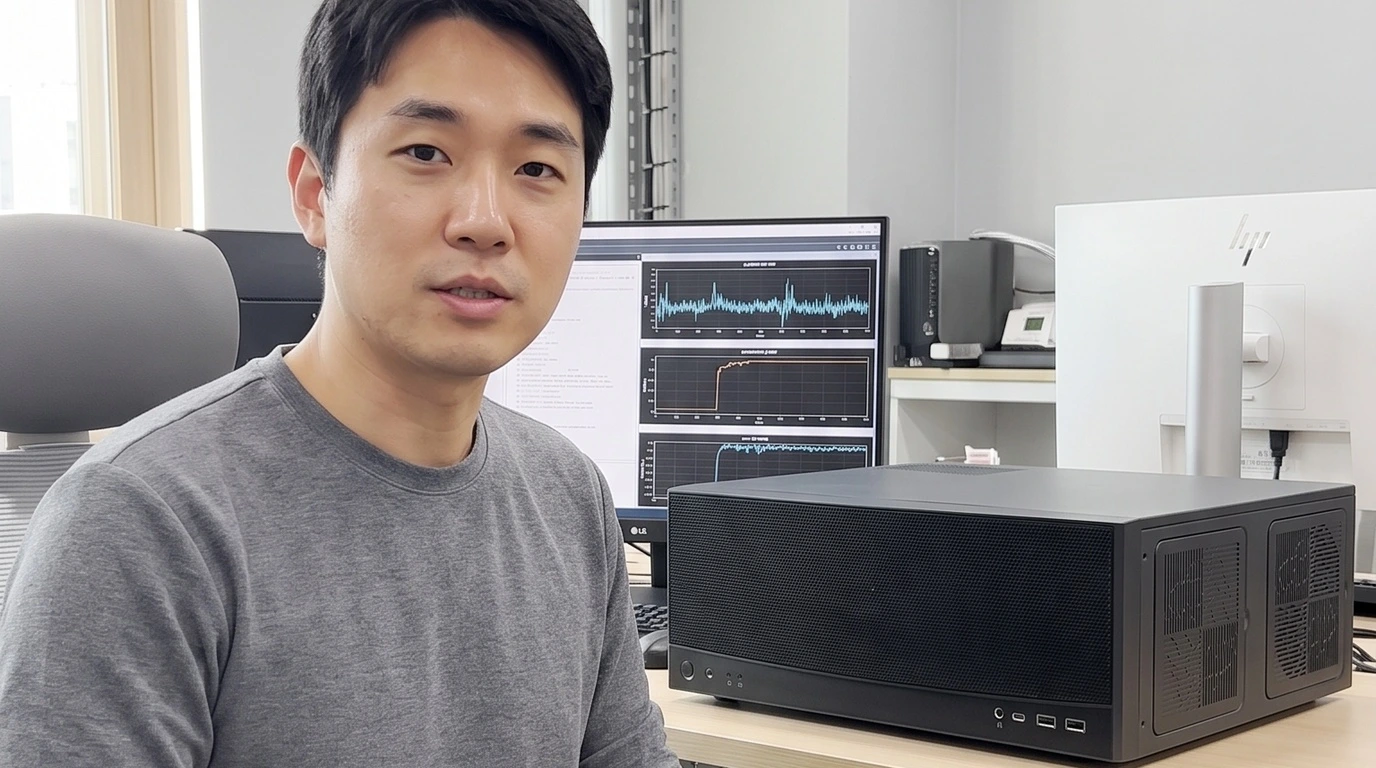
Quick Takeaways (TL;DR)
For SMBs, design studios, and R&D engineering teams adopting generative AI, the primary obstacle is the twin squeeze of VRAM capacity limits and hardware costs: consumer GPUs (12GB/16GB) frequently trigger Out-of-Memory (OOM) crashes on 27B dense LLMs and MiniMax-H3 high-resolution pipelines; cutting-edge enterprise accelerators (A100/H100/L40S) cost tens of thousands of dollars; and public cloud APIs generate mounting monthly invoices while risking proprietary IP leakage.
Rigorous engineering benchmarks confirm that secondary-market enterprise NVIDIA Tesla V100 32GB PCIe accelerators represent the ultimate cost-performance breakthrough. Delivering 900 GB/s memory bandwidth over an HBM2 architecture, 32GB of enterprise ECC VRAM, and mature Tensor Core FP16 acceleration, a single card natively hosts MiniMax-H3 / ComfyUI pipelines (1.5s/image throughput) and Qwen3-27B dense LLM inference with over 15GB of dedicated KV Cache. Housed within the ALNETS AiW-V workstation with custom forced-air wind tunnels and whisper-quiet power delivery, total hardware acquisition sits around $1,200-$1,400, typically achieving full TCO payback in 1.5 to 2 months against cloud APIs.
1. AI Compute Dilemma & The "Value Inversion" of Legacy GPUs
When enterprises integrate generative AI into daily production workflows (such as batch e-commerce image rendering, marketing copy generation, and proprietary RAG knowledge retrieval), three critical bottlenecks inevitably emerge:
- 1. Consumer GPU VRAM Anemia: While modern RTX 4070 (12GB) and RTX 4080 (16GB) cards boast high TFLOPS, loading contemporary DiT diffusion pipelines (MiniMax-H3 weights ~12GB + T5-XXL text encoder 8GB + VAE 3GB) instantly exceeds physical VRAM. Enabling CPU system RAM offload causes PCIe bus saturation, increasing rendering latency by 3x to 5x, while 27B LLMs fail immediately with OOM errors.
- 2. Cloud API Financial Drain & Privacy Compromise: Pay-as-you-go APIs appear economical initially, but commercial image generation costs $0.01 to $0.03 per image. Generating 2,000 assets daily consumes $20 to $60 daily ($600 to $1,800/month). Proprietary CAD schematics, client proposals, and audit records pushed to third-party endpoints also violate strict non-disclosure compliance.
- 3. Sky-High Pricing for Flagship Accelerators: The NVIDIA RTX 4090 24GB consistently demands $1,800 to $2,300+ in retail channels, while datacenter-grade A100/H100 systems cost tens of thousands of dollars, presenting prohibitive capital expenditure for mid-market engineering teams.
Against this backdrop, decommissioned enterprise Tesla V100 32GB PCIe cards offer an extraordinary "value inversion": currently circulating in secondary markets for roughly $350 to $480, they deliver a massive 32GB VRAM buffer paired with blistering 900 GB/s HBM2 memory bandwidth—making them the definitive budget weapon for on-premises AI deployment.
2. Hardware Architecture: The Dual Power of HBM2 900 GB/s & 32GB VRAM
Why does memory bandwidth dictate generative AI performance? In both autoregressive LLM token decoding and diffusion denoising iterations, compute core TFLOPS rarely act as the primary constraint; rather, memory bandwidth represents the true physical bottleneck governing token-per-second velocity and batch image generation throughput.
During LLM autoregressive inference, generating each single token requires the GPU to stream the entire active model parameter weights from VRAM through the compute cores once. The theoretical memory fetch volume follows: B_token ≈ 2 × P (FP16/BF16 mode) or 0.55 × P (INT4 quantized) where P is parameter count. If memory bandwidth is constrained, compute cores stall waiting for weight transfers.
| GPU Model | VRAM Spec / Type | Bus Width | Memory Bandwidth | Hardware ECC | Estimated Acquisition Cost |
|---|---|---|---|---|---|
| NVIDIA Tesla V100 (PCIe) | 32 GB HBM2 (Stacked High-Bandwidth) | 4096-bit (Ultra-wide bus) | 900 GB/s (Near terabyte/s) | Supported (Native Hardware ECC) | ~$380 - $480 USD |
| GeForce RTX 3090 | 24 GB GDDR6X | 384-bit | 936 GB/s | Not supported | ~$750 - $900 USD |
| GeForce RTX 4080 | 16 GB GDDR6X | 256-bit | 716 GB/s | Not supported | ~$950 - $1,150 USD |
| GeForce RTX 4070 | 12 GB GDDR6X | 192-bit | 504 GB/s | Not supported | ~$550 - $650 USD |
As the comparative matrix illustrates: the V100 leverages its 4096-bit stacked HBM2 memory architecture to deliver 900 GB/s bandwidth matching the RTX 3090, but offers 33% more VRAM capacity (32GB vs 24GB) at roughly half the acquisition cost. This 8GB buffer differential represents the exact dividing line between hosting full MiniMax-H3/Flux image synthesis pipelines alongside 27B dense LLMs locally versus suffering terminal OOM crashes.
3. Practical Pipeline 1: MiniMax-H3 & ComfyUI Local Image Generation
MiniMax-H3 and modern DiT (Diffusion Transformer) image synthesis architectures set new standards for prompt comprehension, complex typography rendering, and photorealistic lighting, yet demand substantial VRAM footprints. In production ComfyUI workflows, the memory breakdown for standard 1024x1024 resolution rendering is as follows:
- 1. Primary DiT Transformer Backbone (FP16/FP8 hybrid): Consumes approximately 10.5 to 12.0 GB VRAM;
- 2. T5-XXL Text Encoder (High-dimensional semantic parsing): Consumes roughly 8.2 to 9.0 GB (FP16) or ~4.5 GB (INT8 optimized);
- 3. VAE Encoder/Decoder & Latent Space Activation Cache: Dynamically allocates 2.5 to 3.5 GB during reverse diffusion;
- 4. Industrial LoRA Style Adaptations & ControlNet Edge/Depth Constraints: Loading 2-3 weights allocates 1.5 to 2.2 GB.
Production Performance on 32GB VRAM: Total steady-state allocation reaches 22.7 to 26.5 GB. On conventional 24GB consumer cards, workflows are forced to engage CPU memory offloading to swap text encoders back and forth over PCIe, injecting 2.5 to 4.0 seconds of latency per image. On the V100 32GB, all models and latent buffers remain pinned within ultra-fast HBM2 VRAM, achieving stable 1024x1024 generation latencies of 1.4 to 1.8 seconds per asset. With Batch Size = 2 concurrency enabled, daily commercial rendering capacity easily exceeds 10,000 images.
4. Practical Pipeline 2: Qwen3-27B Local Inference & KV Cache Planning
For enterprise intelligence and R&D knowledge retrieval, 7B/8B lightweight models often exhibit hallucinations and logic degradation during rigorous contract audits, complex code reviews, and structured data synthesis. Conversely, 27B to 32B dense models (such as Qwen3-27B) deliver enterprise-grade cognitive reasoning rivaling prior-generation 70B systems. Hosting this class of model reliably on a single V100 32GB requires meticulous VRAM and KV Cache budgeting:
- 1. Model Weight Allocation: Native FP16 weights require 54GB (exceeding single-card limits). Employing production-grade AWQ or GPTQ INT4 quantization compresses static model weights down to 14.8 to 15.5 GB, preserving 98%+ of cognitive and logical capabilities;
- 2. Runtime Overhead: CUDA context buffers and inference execution engines require approximately 1.2 GB;
- 3. Dynamic KV Cache Budget: 32 GB total VRAM - 15.5 GB weights - 1.2 GB driver overhead = an impressive 15.3 GB dedicated purely to KV Cache! In contrast, a 24GB card retains only ~7.3 GB for active context.
Under modern PagedAttention memory management (via vLLM or SGLang), 15.3 GB of KV Cache easily supports 50,000+ concurrently active context tokens. In practice, this enables a single workstation to effortlessly deliver 28 to 35 tokens/s for deep 32k-context document evaluations by senior engineers, while simultaneously servicing 8 to 12 concurrent enterprise staff querying internal knowledge repositories without OOM degradation.
5. Enterprise TCO & ROI Model: Achieving Full Payback in 2 Months
When enterprise leadership evaluates hardware capital allocations, the deciding criterion is always tangible ROI. The following financial model reflects actual production throughput from a typical 15 to 30-person cross-border commercial team or engineering studio:
- Production Baseline: 2,500 high-resolution marketing assets generated daily via automated ComfyUI pipelines; 600,000 tokens of internal technical retrieval and customer proposal drafting daily.
| Metric / Cost Item | Option 1: Public Cloud APIs | Option 2: On-Prem V100 32GB Workstation |
|---|---|---|
| Initial Hardware Capex | 0 USD (No hardware capex) | ~$1,250 - $1,350 USD (Turnkey system) |
| Daily Image Synthesis (2,500 images) | ~$17.50 USD/day ($0.007/image commercial rate) | 0 USD (Local execution) |
| Daily LLM Tokens (600k tokens) | ~$2.50 USD/day ($0.004/1k tokens commercial tier) | 0 USD (Local inference) |
| Monthly Electricity (280W average load) | 0 USD | ~$22.00 USD/month (Continuous 24/7 commercial power) |
| Total Monthly Opex | ~$600.00 USD / month | ~$22.00 USD / month |
| IP & Commercial Privacy | Data resides on third-party multi-tenant clouds | 100% on-premises physical sovereignty |
| Capital Payback Period | N/A (Perpetual recurring expense) | Full hardware ROI achieved in ~2.2 months! |
The financial analysis demonstrates that by reallocating merely two months of public cloud API operating expenditure into an on-premises V100 32GB workstation, the enterprise generates over $570/month in net cash-flow savings beginning in Month 3. Across the first year, cumulative savings exceed $6,800, while converting ephemeral operational expense into a permanent high-value corporate asset.
6. Hardware Foundation: ALNETS AiW-V Workstation Engineering
Many engineering hobbyists have attempted to install decommissioned V100 cards into standard desktop consumer PCs, only to suffer immediate operational failure: datacenter accelerators utilize passive heatsink architectures engineered exclusively for high-pressure, ducted server chassis airflow. Standard desktop case fans cannot generate the static pressure required to overcome the dense fin resistance, causing V100 core temperatures to spike past 90°C within 30 seconds of workload execution, triggering emergency throttling or thermal shutdown.
The ALNETS AiW-V Compute Workstation is purpose-engineered to overcome these exact thermal, electrical, and acoustic barriers in corporate office environments:
- 1. Custom Forced-Air Wind Tunnel & High-Pressure Blower: Features precision-molded directional airflow shrouds mated to high-static-pressure dual-ball-bearing industrial blowers. This forces high-velocity cooling air directly through the dense heatsink channels, sustaining steady GPU core temperatures of 68°C to 74°C under 100% full-throttle rendering and inference.
- 2. Enterprise-Grade Power Delivery: Equipped with 80Plus Gold/Platinum 1200W-1600W server-grade power supplies providing dedicated 8-pin high-gauge copper lines capable of effortlessly absorbing transient GPU power spikes during multi-modal batch processing.
- 3. Intelligent Dynamic Acoustic Attenuation: Eliminates the deafening 75dB screech of server rooms. Smart temperature-linked PWM tuning keeps idle acoustic levels below 38dB (whisper-quiet office baseline), and full-load rendering noise below 48dB—enabling seamless deployment directly beside executive workstations.
- 4. Scalable PCIe Topologies: Generous full-length PCIe 3.0/4.0 x16 slot spacing and pre-routed power lines allow businesses to smoothly drop in a second V100 to achieve a 64GB dual-GPU cluster, scaling up to run 70B-class models without replacing the host chassis.
7. Frequently Asked Questions (FAQ)
Q1: The Tesla V100 is based on the Volta architecture (sm_70) without native BF16/FP8 hardware registers. Does this present compatibility or accuracy bottlenecks with contemporary models?
A1: Extensive production validation confirms zero compatibility blockers. The V100 incorporates 640 first-generation Tensor Cores engineered specifically for high-throughput FP16 matrix mathematics (delivering 125 TFLOPS of half-precision compute). Leading modern inference engines (including vLLM, SGLang, Ollama, and TensorRT-LLM) maintain rock-solid sm_70 kernel optimization. When deploying models originally pre-trained in BF16, modern runtimes seamlessly downcast weights into FP16 or AWQ/GPTQ INT4 representations at load time. Under INT4 quantization, weights dequantize on-the-fly and accumulate across FP16 Tensor Cores. Output quality and perplexity remain virtually identical to native runs, while HBM2 bandwidth frequently outperforms GDDR6-bound consumer alternatives.
Q2: Within a similar $400-$600 budget envelope, why choose a V100 32GB over a consumer RTX 3090 24GB?
A2: The distinction comes down to absolute VRAM thresholds and enterprise uptime stability. First, VRAM capacity represents an unyielding barrier: executing full MiniMax-H3 generation pipelines (DiT + T5 + VAE + LoRAs) requires 22 to 26 GB steady-state VRAM, while INT4 27B LLMs demand ~16 GB. On a 24GB RTX 3090, complex high-res generations frequently hit OOM limits, and 27B LLM context caches are squeezed to under 7GB, failing under concurrent staff queries. The V100 32GB handles full pipelines without offloading and provides 15GB+ dedicated KV Cache for true concurrency. Second, the V100 features enterprise hardware ECC memory correction, eliminating bit-flip crashes during 24/7 commercial operations that plague consumer-grade cards.
Q3: How does the ALNETS AiW-V workstation perform regarding acoustic noise and thermal dissipation when operating in an office environment?
A3: The ALNETS AiW-V undergoes rigorous aero-acoustic testing. During idle or lightweight productivity tasks, intelligent PWM fan curves throttle blowers down, maintaining operational acoustics below 38dB (blending imperceptibly into ambient office noise). Under continuous 100% load during batch MiniMax-H3 image generation or 27B inference, the custom high-pressure ducting evacuates heat directly through the rear exhaust, keeping the GPU core between 68°C and 74°C while capping full-load noise below 48dB (equivalent to quiet conversational tones). It operates reliably right beside engineering desks without requiring a server room.
ARCHITECTURE & HARDWARE SYNERGY
Recommended Products & Bundles
Hardware appliances, gateways, and collaborative suites referenced in this guide:
AiW-V Compute Workstation Details
Integrated hardware topology, security boundary, and turnkey suite
Education & Enterprise Local AI Solution
Integrated hardware topology, security boundary, and turnkey suite
Higher Ed & Research AI Gateway & Compute Governance
Establish an authoritative campus AI gateway hub for universities and research institutes. Unifies external cloud LLMs with on-premise private models (powered by AiW 6-GPU compute hosts and AiW-V workstations)—preventing curriculum and research data leakage while assigning tailored models across STEM, humanities, medicine, and arts for multidisciplinary AI diversity.