
ALNETS · Technical articles
Hardware Proxy Router vs. Anti-Detect Browser: Why Physical Network Isolation Matters for TikTok & Multi-Store Matrices
A comprehensive technical comparison between traditional software anti-detect browsers and dedicated hardware proxy routers (ALNETS BPR-W / PCR-W) for TikTok Shop, Amazon, and multi-store e-commerce operations. Examines why software-only spoofing fails against real mobile devices (TikTok/Shopee apps), kernel-level Kill-Switch leakage risks, LAN ARP broadcast cross-contamination, and TCP/IP stack mismatches, demonstrating why physical-layer network isolation provides the definitive defense for scale matrix operations.
Quick Takeaways (TL;DR)
In multi-account operations across cross-border e-commerce (Amazon, TikTok Shop, eBay, Shopee, Etsy) and social media matrices, anti-association is the foundational baseline determining operational survival. Today, most teams rely on software-only stacks: anti-detect browsers (such as AdsPower or Multilogin) paired with residential proxies. However, as platform anti-fraud models penetrate down from Layer 7 (Application) into Layer 3/4 (Transport/Network) and Layer 1/2 (Physical/Data Link), software-only approaches exhibit three critical, unavoidable structural flaws.
First, anti-detect browsers only operate within desktop browser environments, masking Web APIs (User-Agent, Canvas, WebGL, font enumeration). They are completely useless for real mobile hardware (iPhone/Android running native TikTok, Shopee, or Instagram apps), which possess operating system permissions to query local Wi-Fi BSSIDs, gateway MACs, and ambient RF RSSI vectors. Second, when desktop proxy clients crash, jitter, or reconnect, outbound TCP connections silently fall back to raw direct LAN routing, leaking the operator's genuine domestic ISP IP within milliseconds. Third, all workstations in an office inevitably share one physical broadcast domain, gateway ARP identity, and subnet hop, allowing deep network scans to cluster separate stores instantly.
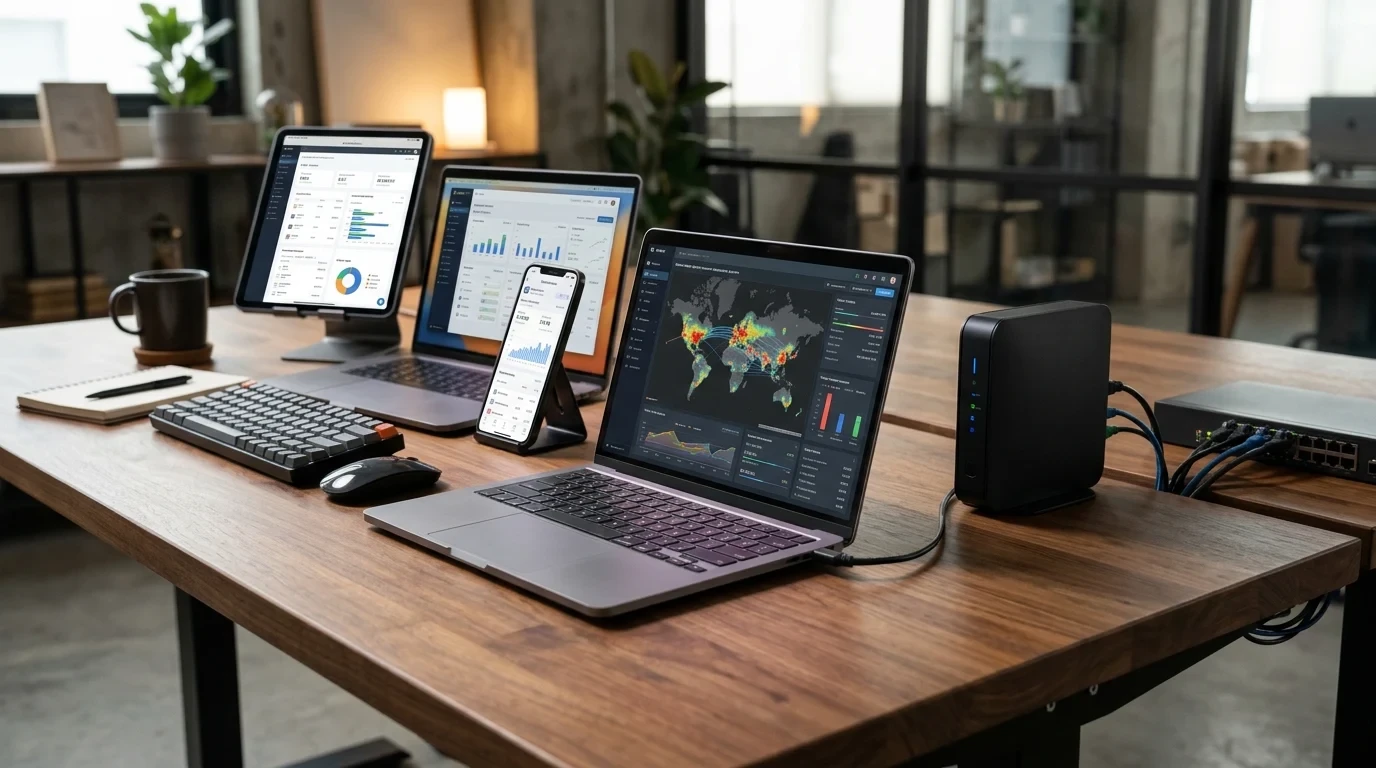
The definitive defense must be constructed upon physical hardware and network protocol layer isolation. ALNETS BPR-W and PCR-W dedicated soft routers partition up to 60 to 100 fully isolated virtual wireless APs (each with a dedicated hardware BSSID, isolated /24 DHCP subnet, segregated NAT table, and VLAN air-gap). At the operating system core, a kernel-level Kill-Switch drops all non-tunneled egress packets instantly upon tunnel failure, while PCR-W implements a dual-layer Relay + Landing proxy chain. Whether managing phone racks or desktop workstations, devices operate driverless and clientless, eliminating all correlation vectors at the physical layer.
Comprehensive Technical Matrix: Anti-Detect Browser vs. Hardware Proxy Router
A comprehensive side-by-side comparison across 6 core technical dimensions:
| Evaluation Dimension | Traditional Software Anti-Detect Browser | ALNETS BPR-W / PCR-W Hardware Router |
|---|---|---|
| Supported Device Types | Desktop PCs only (Windows / macOS / Linux). Completely unusable on real mobile phones (iOS/Android) | Universal compatibility: Real mobile phones (iPhone/Android), tablets, PCs, and edge boxes connect via isolated Wi-Fi or LAN |
| Isolation Depth & Scope | Application layer only (Layer 7): Spoofs Canvas, WebGL, AudioContext, and User-Agent headers | Full physical to transport layer (Layers 1-4): Unique hardware MACs, isolated BSSIDs, /24 subnets, and segregated NAT |
| Proxy Crash & Leak Risk | Extreme hazard: Process crashes or timeouts silently revert TCP traffic to direct WAN routing, leaking real ISP IP instantly | Zero-leak guarantee: Kernel-enforced Kill-Switch state machine drops unencrypted packets unconditionally; zero fallback |
| LAN & Gateway Fingerprint | Shared exposure: All browser profiles share identical default gateway IP, router ARP MAC, and broadcast collision | Total isolation: Each virtual SSID binds to an isolated VLAN and /24 subnet; ARP broadcasts cross-zero boundaries |
| TCP/IP Stack Consistency | Stack mismatch: Windows desktop traffic forwarded over Linux proxy servers creates anomalous TTL (128 vs 64) and MTU signatures | Protocol normalization: Router firmware rewrites outbound TTL and MTU values to match target residential broadband standard |
| System Resource Overhead | Heavy overhead: Each active browser profile consumes 400MB to 1GB RAM and persistent CPU, causing frequent crashes | Zero local burden: Cryptographic proxying and network shunting are fully offloaded onto the multi-core router hardware |
Three Fatal Vulnerabilities of Software-Only Anti-Detect Browsers
Many cross-border sellers observe catastrophic ban waves even after deploying anti-detect browsers and residential proxies across every PC. Forensic examination of raw packet captures reveals three fatal underlying vulnerabilities:
- 1. Mobile Native Apps Penetrate Sandboxes to Probe Hardware and RF Vectors: In TikTok live streaming, Shopee operations, and WhatsApp marketing, real smartphones (iPhones and Android devices) are indispensable. Mobile operating systems provide native apps with comprehensive system inspection APIs. The TikTok mobile app directly scans and records the connected AP BSSID (hardware MAC), signal RSSI, surrounding neighbor Wi-Fi broadcast signatures, and default gateway ARP mappings. Software anti-detect browsers cannot run on mobile devices. When dozens of phones in a studio connect to an ordinary consumer Wi-Fi network, every device transmits identical BSSID clusters and gateway MACs, resulting in immediate association penalties.
- 2. Silent Raw Connection Leaks During Proxy Jitter or Crashes: Software proxy clients running in user-space (such as desktop daemon processes, Proxifier, or browser extensions) are vulnerable to OS thread scheduling and network hiccups. When an overseas proxy server jitters, times out, or crashes, the standard operating system socket behavior falls back to direct physical network interface routing. Without a hardware barrier, browser tabs silently establish un-proxied TCP handshakes, transmitting the merchant's actual domestic ISP IP straight to Amazon or TikTok servers. Even if this leak lasts under 500 milliseconds, platform threat-detection systems permanently log the domestic IP fingerprint, triggering subsequent account purges.
- 3. LAN Broadcast Overlap and Gateway MAC Collision: In a standard studio, 20 to 50 workstations plug into common Ethernet switches or one wireless network. Platform client-side scripts exploit WebRTC ICE candidate gathering and local network discovery techniques to map internal subnets (e.g., 192.168.1.15 adjacent to 192.168.1.16). Crucially, the Layer 2 destination MAC for all outbound frames points to the identical office default gateway. Through graph-based correlation analytics, platform fraud-detection systems readily identify that dozens of ostensibly independent stores share an identical physical network origin, classifying them as an illicit multi-store syndicate.
Under the Hood: BPR-W & PCR-W Hardware Anti-Association Architecture
To definitively eliminate these network vulnerabilities, ALNETS engineered the BPR-W (Batch Proxy Wireless Router) and PCR-W (Proxy Chaining Soft Router) hardware platforms:
- Single-Chassis 60 to 100 Hardware-Isolated Virtual APs: BPR-W integrates specialized RF silicon and kernel-tuned high-concurrency wireless drivers to broadcast up to 60 (or 100 on enterprise models) concurrent SSIDs. Each virtual AP features a distinct physical MAC prefix, dedicated /24 DHCP subnet, segregated NAT state table, and independent radio timeslot scheduling—guaranteeing that every smartphone or PC connects to a physically unique, non-interfering network environment.
- Kernel-Enforced Kill-Switch Fail-Safe: Traditional proxy software runs in user-space, unable to halt kernel packet forwarding when disrupted. ALNETS router firmware embeds the Kill-Switch logic directly into the Netfilter kernel state machine. If an egress tunnel experiences packet loss, DNS timeout, or socket collapse, the kernel drops non-tunneled egress packets at the NIC driver layer within microseconds, mathematically guaranteeing zero domestic IP exposure.
- Dual-Layer Relay + Landing Proxy Chaining: The PCR-W hardware gateway executes a two-hop proxy pipeline in silicon. The first hop ("Relay") routes traffic through high-throughput low-latency transit nodes in Hong Kong or Tokyo; the second hop ("Landing") connects directly to clean residential broadband IPs within the target destination country. This architecture sustains sub-180ms round-trip latency while ensuring that any platform traceback reaches only transit relays, permanently severing probes into domestic office infrastructure.
- ALBulk Centralized Fleet Management: For scale operations with dozens of phones and hundreds of stores, BPR-W is equipped with the ALBulk management console. Administrators can import, assign, and update SOCKS5/HTTP proxy credentials across all 60 SSIDs in batch, switch destination countries instantly, and monitor real-time throughput and packet health per channel—eliminating manual configuration errors across individual devices.
Recommended Deployment Architecture for Multi-Store Matrix Operations
Based on matrix scale and device types, ALNETS recommends two battle-tested production topologies:
- 1. Smartphone Matrix Mode (TikTok Live Streaming, Shopee Video Farming): Deploy 1 BPR-W router connected to the primary ISP modem, provisioning 60 isolated virtual wireless SSIDs. 60 physical smartphones (iPhone/Android) connect 1:1 to dedicated SSIDs without rooting, jailbreaking, or software proxy clients. Out-of-the-box, each phone accesses clean overseas residential connectivity with zero configuration friction. Pairing with PCR-W dual-layer chaining guarantees smooth 1080P live streams, preventing 0-view shadowbans and cross-device correlation.
- 2. Desktop Multi-Store Mode (Amazon, eBay, Etsy Enterprise Operations): Adopt a defense-in-depth model combining "hardware isolation as the base, anti-detect browser as the supplement." Workstations connect to dedicated BPR-W channels for physical MAC segregation, subnet partitioning, TCP/IP stack normalization, and kernel Kill-Switch protection. Desktop anti-detect browsers handle application-layer isolation (Canvas, WebGL, cookies). If browser software stumbles or proxies flap, the underlying BPR-W halts non-proxied packets instantly, keeping the physical IP fully shielded.
Frequently Asked Questions (FAQ)
Common engineering and procurement questions regarding hardware proxy routers:
- Q: Since BPR-W enforces hardware-grade anti-association, can teams completely eliminate costly anti-detect browser subscriptions on desktop? A: Absolutely yes. For standard multi-store operations where each store is operated from a dedicated workstation or mini PC, connecting via isolated BPR-W subnets using stock, unmodded Chrome or Edge browsers provides complete physical and network isolation. This eliminates thousands of dollars in recurring software seat licenses annually. Anti-detect browsers are only strictly necessary when running 10+ store profiles simultaneously on a single physical PC, in which case BPR-W serves as the vital fail-safe shield against catastrophic raw IP leaks.
- Q: For TikTok phone matrices, why not simply equip each phone with an international roaming SIM card instead of using BPR-W? A: Overseas roaming SIM cards suffer from three severe operational drawbacks: 1) Prohibitive recurring cost: data packages for 60 roaming SIMs frequently exceed thousands of dollars monthly. 2) Flapping dynamic exit IPs: cellular carriers rotate roaming endpoints unpredictably, preventing the static residential persistence required for store longevity. 3) Cellular tower clustering: phones in the same room lock onto identical local cellular base station IDs (Cell ID) and LAC vectors, triggering geolocation clustering bans. BPR-W routes through enterprise fiber to pristine residential egresses, reducing connectivity costs by >80% while maximizing stability.
- Q: When hosting 60 concurrent smartphones streaming HD video or broadcasting live, will BPR-W suffer RF congestion, packet loss, or thermal throttling? A: Absolutely not. Unlike consumer routers built with low-power chips, BPR-W is engineered around a dedicated multi-core processor, high-throughput enterprise RF frontends, generous memory, and kernel-level Airtime Fairness scheduling paired with hardware QoS. In stress tests with 60 devices streaming 1080P video simultaneously, CPU utilization remains well under 35%, with passive all-metal chassis dissipation ensuring continuous, uninterrupted 24/7 reliability.
ARCHITECTURE & HARDWARE SYNERGY
Recommended Products & Bundles
Hardware appliances, gateways, and collaborative suites referenced in this guide:
BPR-W Wireless Batch Proxy Router
Integrated hardware topology, security boundary, and turnkey suite
PCR-W Proxy Chaining Router
Integrated hardware topology, security boundary, and turnkey suite
Multi-Device Matrix Networking Solution
Integrated hardware topology, security boundary, and turnkey suite
Enterprise AI API Gateway & Multi-Device Synergy
Establish an authoritative, governed AI infrastructure for enterprise teams—eliminating fragmented configs, uncoordinated upstream accounts, credential leaks, and untracked API costs.