
ALNETS · Technical articles
Enterprise Team Private Knowledge Base Implementation: Practical Guide to 100% Offline RAG on AE-2000 Edge Host
A deep architectural dive into the dilemma facing 5 to 30-person teams (law firms, architectural studios, financial audits, cross-border engineering): public SaaS knowledge bases risk exposing proprietary IP, contracts, and schematics, while traditional rack servers are too noisy and power-hungry for office environments. Details an end-to-end 100% on-premises offline RAG deployment on the AE-2000 edge compute host: covering multi-format chunking, local BGE embedding models, hybrid retrieval (BM25 + dense vector similarity) in Chroma/Milvus, and cross-encoder reranking achieving sub-200ms recall. Explores the AE-2000 die-cast fanless cooling (0dB silent operation), ultra-low power consumption for 24/7 continuous uptime, and dual Gigabit LAN physical isolation with comprehensive sizing equations and TCO payback models.
Quick Takeaways (TL;DR)
For professional boutique teams of 5 to 30 people (such as law practices, accounting firms, architectural studios, and specialized engineering groups), the primary obstacle to deploying private knowledge bases (RAG) is rarely algorithmic complexity, but rather physical and compliance constraints: public cloud SaaS platforms pose grave data-leakage and model-training contamination risks for proprietary contracts and schematics; datacenter rack servers generate 50-70dB of piercing fan noise and high power draw unsuited for open-plan offices; and hosting services on personal desktop PCs inevitably suffers from sleep timeouts, accidental shutdowns, and network drops.
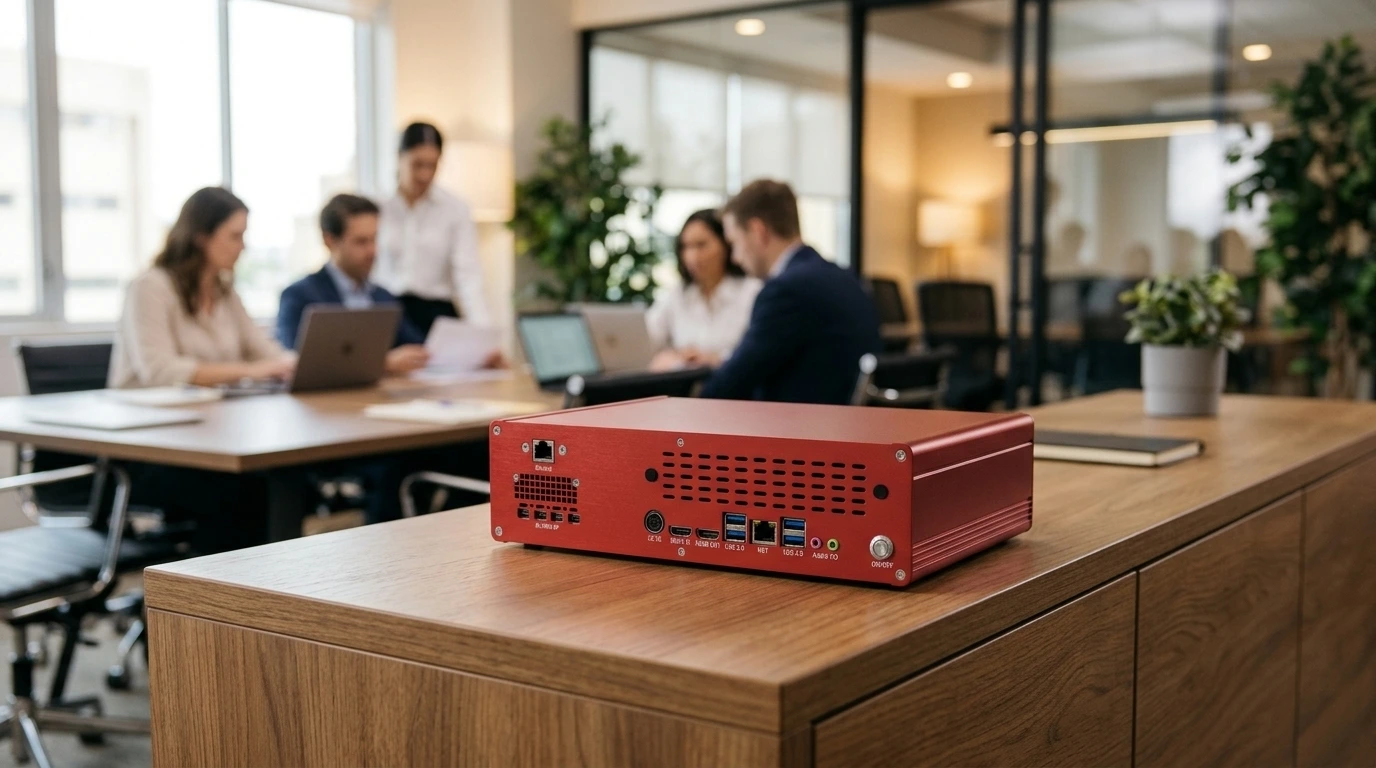
The proven enterprise solution is Edge-Native RAG: deploying an industrial fanless edge computer (ALNETS AE-2000) as the dedicated office knowledge hub. Operating at 0dB absolute silence with ultra-low wattage, it connects directly into the local office LAN. Powered by local BGE embedding models, embedded vector storage, hybrid search (BM25 + Dense Vectors), and Cross-Encoder reranking, it guarantees 100% offline data sovereignty with sub-200ms retrieval latencies entirely within the physical premises.
1. Three Core Engineering Dilemmas in SMB Private Knowledge Bases
Small and medium professional teams attempting to build internal knowledge retrieval frequently find themselves trapped between cloud convenience and local infrastructure complexity. In practice, three acute dilemmas emerge:
- 1. Data Compliance Redlines & Cloud Exposure Risks: Case archives in legal firms, audit workpapers, and proprietary CAD manufacturing drawings demand absolute secrecy. When utilizing public cloud SaaS RAG services, documents are pushed to third-party multi-tenant storage. Despite non-training pledges, privilege escalation vulnerabilities, accidental public sharing links, and transit interception pose unacceptable liability and compliance exposure.
- 2. Office Hostility of Datacenter Rack Servers: Conventional enterprise rack servers (1U/2U) are engineered exclusively for climate-controlled, soundproofed server rooms. Their high-speed cooling fans (8000 to 15000 RPM) emit continuous 55dB to 75dB high-frequency whining—equivalent to an active vacuum cleaner beside office desks. Drawing 300W to 800W, they quickly overheat in unventilated office closets, causing hardware throttling and crashes.
- 3. Fragility of Ad-Hoc PC Hosting: Some teams attempt to run RAG scripts on a colleague workstation or spare laptop. However, personal PCs inevitably suffer from OS sleep timeouts, automated reboot updates, aggressive firewall port blocks, and sudden offline periods when the machine is transported or the owner departs, instantly paralyzing workflow continuity.
| Evaluation Dimension | Public Cloud SaaS RAG | Personal PC Ad-Hoc Host | AE-2000 Edge Knowledge Hub |
|---|---|---|---|
| Data Privacy & Sovereignty | High Risk: Data traverses public clouds | Fair: Local, but exposed to workstation malware | Excellent: 100% on-premises physical isolation |
| Operating Noise Level | N/A: No local hardware | Moderate: 30-45 dB desktop fan noise | Superior: 0 dB completely fanless die-cast |
| 24/7 Service Availability | High: Cloud vendor SLA dependent | Poor: Interrupts on sleep, reboots, or wifi drops | Excellent: Industrial watchdog, 99.99% uptime |
| Ongoing Operating Cost (TCO) | High: Per-seat monthly fee + Token billing | Variable: Frequent downtime disrupts teams | Low: One-time hardware asset, ultra-low power |
2. End-to-End 100% On-Premises Offline RAG Architecture
Deploying a high-precision, low-latency, and zero-leakage private knowledge base on an enterprise intranet requires a strictly decoupled pipeline. The production-grade Edge-Native RAG stack hosted on the AE-2000 encompasses four core phases:
- 1. Document Parsing & Structure-Preserving Chunking: Ingesting PDFs, DOCX, Markdown, spreadsheets, and scanned documents. Applies recursive character chunking (512 to 800 tokens) with an intentional 15% sliding overlap (80 to 120 tokens), safeguarding clauses, tables, and multi-paragraph technical context from abrupt boundary truncation.
- 2. Local High-Efficiency Embedding Engine: The AE-2000 natively runs state-of-the-art multilingual embedding models (such as BGE-M3 or BGE-Large-zh). BGE-M3 generates 1024-dimensional dense vectors alongside sparse lexical representations across an 8192 context window, processing queries entirely on-premises without external API calls.
- 3. Hybrid Dual-Route Retrieval Engine: Relying solely on vector cosine distance frequently causes semantic hallucinations when querying exact serial numbers, product SKUs, or legal clauses. The AE-2000 pipeline deploys dual-channel concurrent search: BM25 lexical search combined with HNSW vector index, merged via Reciprocal Rank Fusion (RRF) to capture both semantic intent and exact alphanumeric keywords.
- 4. Cross-Encoder Local Reranker: Following the initial retrieval of Top-50 candidate chunks, a compact Cross-Encoder model (such as BGE-Reranker-Large) performs full cross-attention scoring on [Query - Chunk] pairs, eliminating irrelevant noise and feeding only the pristine Top-3 to Top-5 contexts into the prompt, elevating first-pass recall accuracy above 92%.
3. Quantitative Sizing Model: Memory Footprint, Latency, and Throughput
Engineering decisions demand quantitative certainty over guesswork. Memory consumption and latency budgets for edge RAG deployments follow rigorous mathematical models:
[Equation 1: Vector Index RAM Footprint]: M_RAM = N × D × 4 Bytes × (1 + α) + M_OS. Where N represents the total chunk count, D is vector dimensionality (1024 for BGE-M3), single-precision float equals 4 bytes, α is the HNSW graph expansion overhead (0.25 to 0.35), and M_OS is base daemon overhead (~500MB).
[Real-World Sizing Example]: For a boutique firm holding 2,000 technical or legal dossiers (~100,000 parsed chunks): M_RAM = 100,000 × 1,024 × 4 × 1.30 ≈ 532 MB. Factoring in BM25 inverted indices and runtime libraries, the entire 100,000-chunk knowledge base occupies merely 1.2GB to 1.8GB of RAM. The AE-2000 standard 16GB ECC memory comfortably supports hundreds of thousands of documents while leaving ample headroom for concurrent retrieval and localized lightweight inference.
| Intranet Retrieval Stage | Underlying Technology | AE-2000 Benchmark Latency (ms) | Engineering Optimization |
|---|---|---|---|
| Query Embedding Inference | Local BGE-M3 ONNX runtime | 35 - 50 ms | Fixed batch-size, FP16 inference |
| Hybrid Retrieval (BM25 + Vector) | Parallel Top-50 candidate recall | 15 - 25 ms | In-memory index, tuned efSearch |
| Cross-Encoder Reranking | BGE-Reranker Top-5 candidate filter | 90 - 130 ms | Dynamic parallel chunk scoring |
| Prompt Context Assembly | Citation injection & metadata formatting | 5 - 10 ms | Zero-copy buffer streaming to API |
| Total End-to-End Latency | Complete retrieval lifecycle | 145 - 215 ms | Sub-200ms instantaneous response |
4. Hardware Foundation: Why AE-2000 Excels as the Office Knowledge Hub
As an integrated compute foundation for office premises and edge deployments, the ALNETS AE-2000 delivers specialized industrial-grade mechanical and electrical engineering tailored for collaborative workplaces:
- 1. Die-Cast Aluminum Passive Cooling with 0dB True Silence: The AE-2000 eliminates fragile, dust-accumulating mechanical fans. Its chassis utilizes monolithic high-thermal-conductivity die-cast aluminum fins. Natural convective cooling dissipates internal thermal loads silently; even under continuous batch vectorization, the unit maintains 0dB absolute quietness, sitting seamlessly on meeting room credenzas or desks.
- 2. Ultra-Low Power Consumption & Industrial Reliability: Idle power draw lingers at an efficient 15W to 25W, peaking below 65W during heavy retrieval. Unlike power-hungry 400W servers, running the AE-2000 24/7 consumes under 180 kWh annually (costing under 25 per year). Armed with industrial wide-temperature endurance (-20°C to 60°C) and an automatic hardware watchdog, it runs continuously through summer nights without air conditioning.
- 3. Dual Gigabit Physical LAN Isolation & Sovereign Storage: Equipped with two independent Gigabit Ethernet ports (RJ45). LAN1 serves the trusted internal office network for high-speed intranet queries, while LAN2 interfaces with isolated test subnets or connects to the ALNETS AiR Cloud Gateway for secure encrypted external access. All documents and vector databases reside strictly on local NVMe SSDs, operating flawlessly even when disconnected from the WAN.
5. Frequently Asked Questions (FAQ)
Q1: As a dedicated local knowledge retrieval host, how does the AE-2000 integrate with Large Language Models for final response synthesis?
A1: The deployment follows ALNETS modular enterprise architecture. The AE-2000 anchors the knowledge retrieval core (parsing, chunking, vector indexing, and hybrid search). High-confidence context chunks are passed to the inference layer via standard OpenAI-compatible endpoints. Teams choose between two operational paradigms:\n1. [100% Offline Air-Gapped Mode]: Pair with an ALNETS AiW-V workstation (powered by NVIDIA V100 32GB running offline Qwen2.5-14B/27B models) on the same local switch, keeping all prompt synthesis entirely off the public Internet;\n2. [Governed Hybrid Cloud Mode]: Context chunks pass through the ALNETS AiR gateway or the upcoming dedicated enterprise API gateway for token budgeting and encrypted routing to cloud models. Teams easily pivot between air-gapped security and cloud scalability.
Q2: Our team possesses vast collections of scanned contracts and architectural blueprints. Does the AE-2000 support on-premises OCR text extraction?
A2: Fully supported. The AE-2000 includes a hardware-accelerated local OCR pipeline (built on PaddleOCR/RapidOCR engines). For scanned PDFs and high-res schematics, the host automatically executes text detection, skew correction, and character recognition, processing a standard A4 contract page in 300 to 500ms. Extracted text retains page coordinates in the vector metadata, enabling users to trace answers back to highlighted highlights on original scanned documents.
Q3: How do non-technical professionals (lawyers, auditors, business consultants) interact with the knowledge base on a daily basis?
A3: The AE-2000 ships with a turnkey, web-based management console and chat interface. Team members simply access the intranet IP (e.g., http://192.168.1.200) in any browser to drag-and-drop documents, monitor indexing progress, and inspect chunk previews. The portal delivers an intuitive ChatGPT-style conversational assistant with source citations, while offering one-click webhooks for enterprise messaging apps (Lark, WeChat Work, DingTalk). Non-technical staff manage folder permissions and audit logs visually without terminal CLI operations.
Q4: Compared to recurring public SaaS subscriptions, what is the realistic Return on Investment (ROI) for an AE-2000 deployment?
A4: The long-term financial payoff is compelling. Consider a 20-person boutique firm: enterprise SaaS knowledge platforms typically cost 2,500 to 5,000 annually in seat licenses plus overage token charges, while threatening vendor lock-in if subscriptions lapse. In contrast, the AE-2000 represents a one-time capital equipment acquisition. Drawing minimal power (< 25/year in electricity), the hardware typically amortizes and pays for itself within 5 to 8 months of operation, converting operational expense into a permanent, owned enterprise asset.
ARCHITECTURE & HARDWARE SYNERGY
Recommended Products & Bundles
Hardware appliances, gateways, and collaborative suites referenced in this guide:
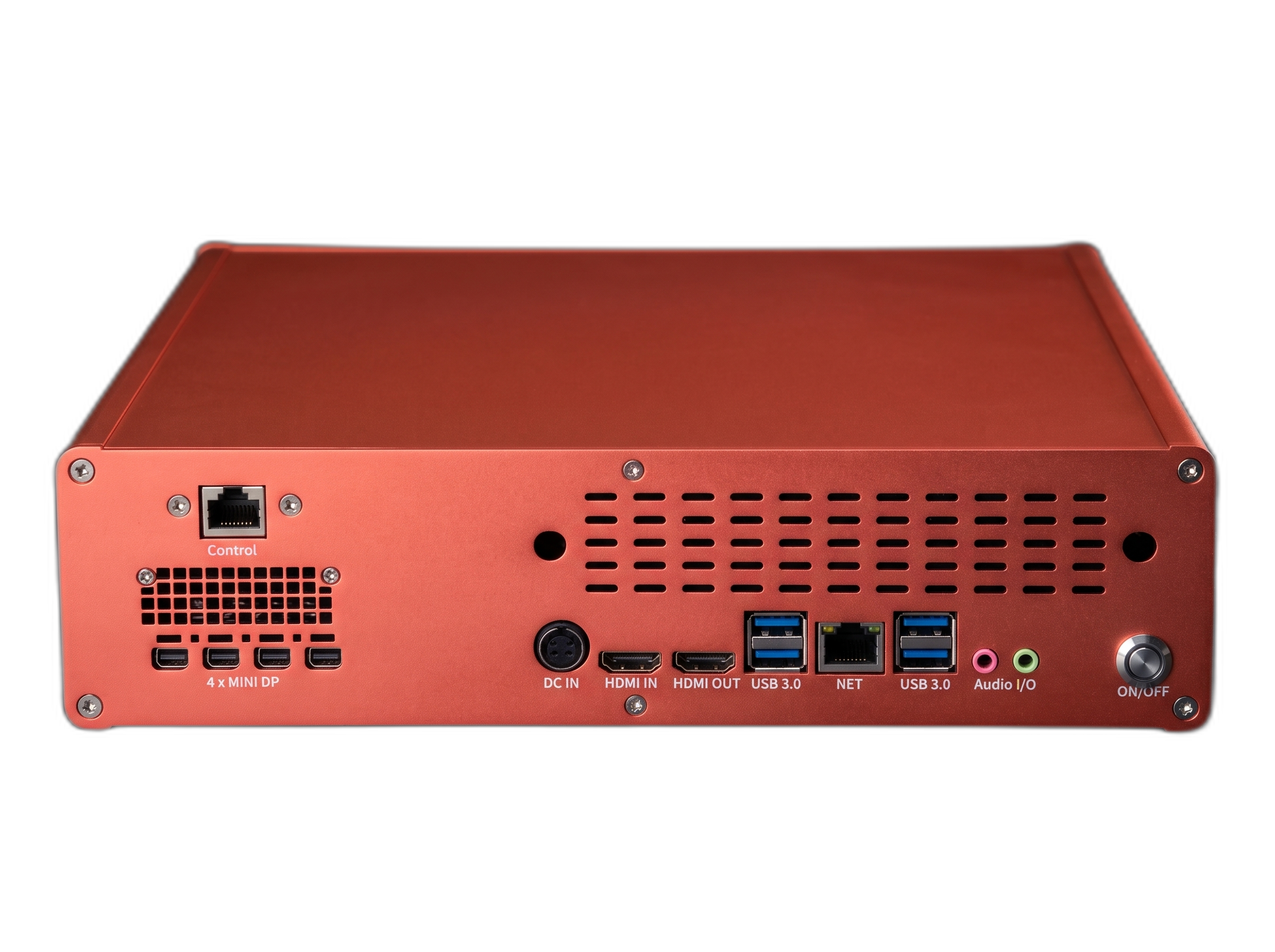
AE-2000 Industrial Edge AI Computer
Local AI compute for industrial and commercial sites, with two system configurations. Both use an NVIDIA RTX 2000 Ada GPU with 16GB GDDR6 ECC memory.
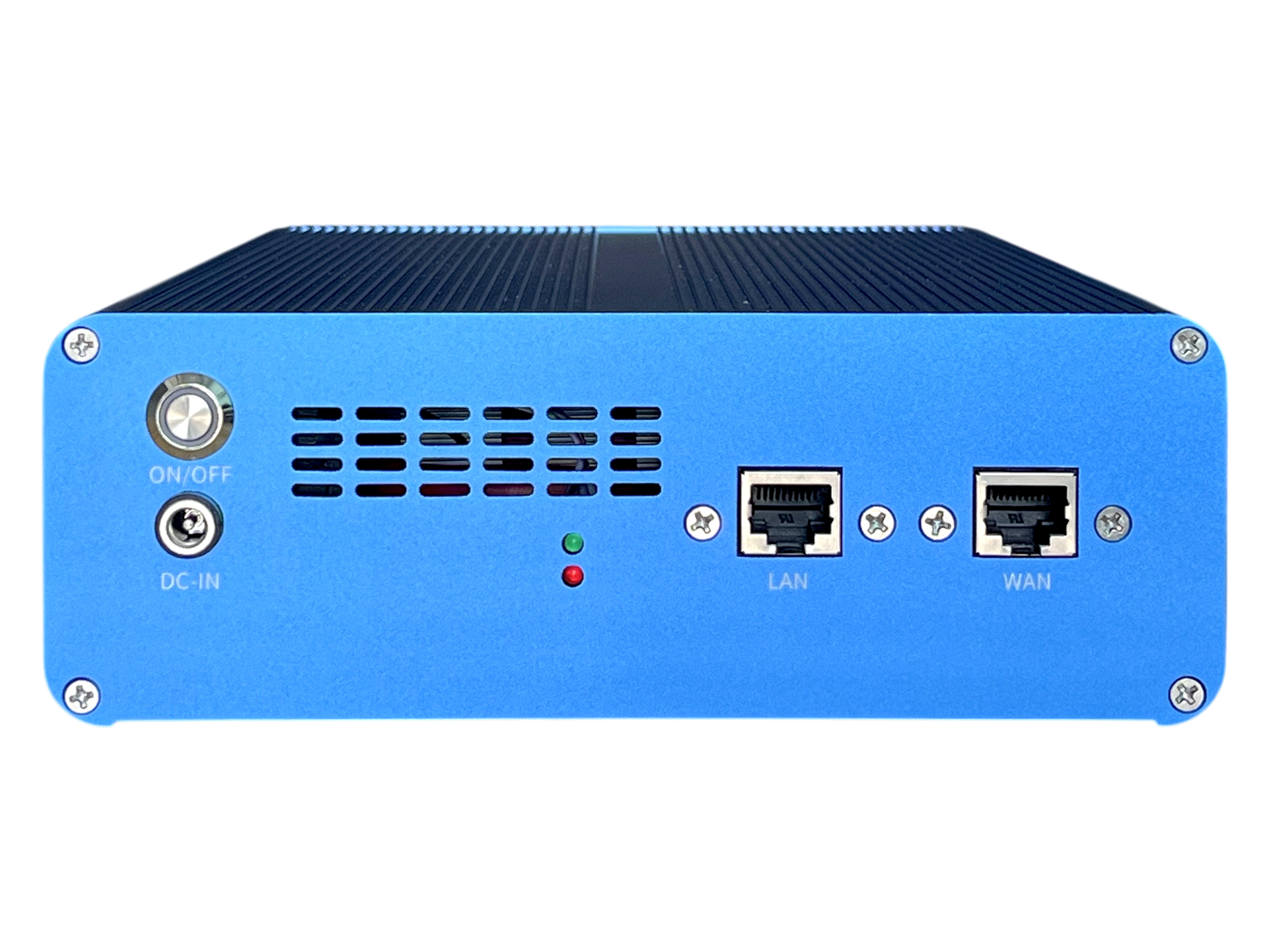
AiR AI Cloud Gateway Router
Secure encrypted tunneling, multi-wan routing and remote access gateway for on-site AI deployments.
AE-2000 Edge Compute Host
Integrated hardware topology, security boundary, and turnkey suite
Enterprise Knowledge Base Solution
Integrated hardware topology, security boundary, and turnkey suite
Enterprise Private Knowledge Base & Q&A Hub
Organize scattered manuals, installation guides, troubleshooting trees, and internal SOPs into an authoritative, private knowledge retrieval engine with complete confidentiality.
7×24 Dedicated Autonomous Agent Workspace
Deploy dedicated AiA agent hosts, AiR secure network egress, API Gateway per-employee model governance, and AE-2000 private knowledge retrieval—organizing role-specific models, docs, and continuous workspaces with full bespoke customization support.